Master Thesis:
  • Proposal
  • Concepts
  • Sketchbooks

On this page

  • Describing Features as Distributions
    • Parameter pvar
      • Maximal aloud Varince for a given Tendency
    • Parameters of the beta distribution
    • Frequency and probability distribution
      • Visualisation and interpretation
    • Alternativ Probability Definition
  • < Back

Features

Author

Hubert Bächli

Published

21.01.2026

Describing Features as Distributions

Parameter pvar

This parameter describes the variance of the beta distribution. For mathematical reasons, the variance is defined relative to the maximum variance permitted for a given mean value. As a consequence, pvar is constrained to values greater than 0 and less than or equal to 1. This definition ensures that the resulting beta distribution parameters are always greater than 1, and that the mode of the distribution lies within the interval (0,1).

Maximal aloud Varince for a given Tendency

tendencies <- 0.3
s_min <- max(1/tendencies,1/(1-tendencies))
s_min
[1] 3.333333
var_max <- tendencies * (1-tendencies) / (s_min + 1)
var_max
[1] 0.04846154

Formally, pvar is defined as follows:

SD <- 0.2
pvar <- max(min(SD^2 / var_max, 1),0.01)
pvar
[1] 0.8253968
varianz <- pvar * var_max 
varianz
[1] 0.04

Parameters of the beta distribution

Finally, this formulation makes it possible to derive a precision parameter and, based on it, the corresponding beta distribution parameters from only two inputs (Tendency, pvar)

calc_beta_par <- function(tendencies, pvar, output = NULL, eps = 1e-6) {
    len <- length(tendencies * pvar)
    df <- data.frame(ten = rep(0, len))
    
    df$ten <- pmin(pmax(tendencies, eps), 1 - eps)
    df$pvar <- pmax(pmin(pvar, 2), eps)
    
    df$ab_min <- pmax(1/df$ten,1/(1-df$ten))
    df$var_max <- df$ten * (1 - df$ten) / (df$ab_min + 1)
    
    df$var <- df$pvar * df$var_max
    
    df$prec <- (df$ten * (1 - df$ten)) / df$var - 1
    
    df$a <- df$prec * df$ten
    df$b <- df$prec * (1 - df$ten)

    if (is.null(output)) {
        return(df)
    } else {
        missing <- setdiff(output, colnames(df))
        if (length(missing) > 0) {
            stop("Unknown output columns: ", paste(missing, collapse = ", "))
        } else {
            df[, output]            
        }
    }
}

calc_beta_par(c(0.1, 0.3, 0.5, 0.7, 0.9), 1)
  ten pvar    ab_min     var_max         var      prec        a        b
1 0.1    1 10.000000 0.008181818 0.008181818 10.000000 1.000000 9.000000
2 0.3    1  3.333333 0.048461538 0.048461538  3.333333 1.000000 2.333333
3 0.5    1  2.000000 0.083333333 0.083333333  2.000000 1.000000 1.000000
4 0.7    1  3.333333 0.048461538 0.048461538  3.333333 2.333333 1.000000
5 0.9    1 10.000000 0.008181818 0.008181818 10.000000 9.000000 1.000000
calc_beta_par(c(0.1, 0.3, 0.5, 0.7, 0.9), 0.5)
  ten pvar    ab_min     var_max         var      prec         a         b
1 0.1  0.5 10.000000 0.008181818 0.004090909 21.000000  2.100000 18.900000
2 0.3  0.5  3.333333 0.048461538 0.024230769  7.666667  2.300000  5.366667
3 0.5  0.5  2.000000 0.083333333 0.041666667  5.000000  2.500000  2.500000
4 0.7  0.5  3.333333 0.048461538 0.024230769  7.666667  5.366667  2.300000
5 0.9  0.5 10.000000 0.008181818 0.004090909 21.000000 18.900000  2.100000
calc_beta_par(c(0.1, 0.3, 0.5, 0.7, 0.9), 0)
  ten  pvar    ab_min     var_max          var     prec       a       b
1 0.1 1e-06 10.000000 0.008181818 8.181818e-09 10999999 1100000 9899999
2 0.3 1e-06  3.333333 0.048461538 4.846154e-08  4333332 1300000 3033333
3 0.5 1e-06  2.000000 0.083333333 8.333333e-08  2999999 1500000 1500000
4 0.7 1e-06  3.333333 0.048461538 4.846154e-08  4333332 3033333 1300000
5 0.9 1e-06 10.000000 0.008181818 8.181818e-09 10999999 9899999 1100000
calc_beta_par(c(0.1, 0.3, 0.5, 0.7, 0.9), 2)
  ten pvar    ab_min     var_max        var     prec         a         b
1 0.1    2 10.000000 0.008181818 0.01636364 4.500000 0.4500000 4.0500000
2 0.3    2  3.333333 0.048461538 0.09692308 1.166667 0.3500000 0.8166667
3 0.5    2  2.000000 0.083333333 0.16666667 0.500000 0.2500000 0.2500000
4 0.7    2  3.333333 0.048461538 0.09692308 1.166667 0.8166667 0.3500000
5 0.9    2 10.000000 0.008181818 0.01636364 4.500000 4.0500000 0.4500000

Frequency and probability distribution

Function that calculates the frequency distribution and the probability distribution for each value of x, for all given parameter sets (tendencies and pvar).

features_dist <- function(x, tendencies, pvar, output = NULL, eps = 1e-6) {
    par <- calc_beta_par(tendencies, pvar, output = c("a","b"), eps)
    lenpar <- length(par$a)
    lenx <- length(x)
    df <- data.frame(
        set = rep(1:lenpar, each = lenx),
        x = rep(x,lenpar),
        a = rep(par$a, each = lenx),
        b = rep(par$b, each = lenx)
    )
    df$freq <- dbeta(df$x, df$a, df$b)
    df$mode <- (df$a - 1) / (df$a + df$b - 2)
    df$mode <- pmin(pmax(df$mode, 0), 1)
    df$max <- ifelse(is.na(df$mode), 
                     df$freq, 
                     dbeta(df$mode, df$a, df$b))
    df$probx <- df$freq / df$max
    df$prob <- pbeta(df$x, df$a, df$b)

    if (is.null(output)) {
        return(df)
    } else {
        missing <- setdiff(output, colnames(df))
        if (length(missing) > 0) {
            stop("Unknown output columns: ", paste(missing, collapse = ", "))
        } else {
            df[, output]            
        }
    }
}

features_dist(x = c(0, 0.5, 1),
              tendencies = 0.6, 
              pvar = 1)
  set   x   a b    freq mode max probx      prob
1   1 0.0 1.5 1 0.00000    1 Inf     0 0.0000000
2   1 0.5 1.5 1 1.06066    1 Inf     0 0.3535534
3   1 1.0 1.5 1     Inf    1 Inf   NaN 1.0000000
features_dist(x = c(0, 0.5, 1),
              tendencies = c(0.3, 0.5, 0.7), 
              pvar = 0.5, 
              output = c("set", "freq", "prob", "probx"))
  set     freq     prob     probx
1   1 0.000000 0.000000 0.0000000
2   1 1.034560 0.883187 0.4164587
3   1 0.000000 1.000000 0.0000000
4   2 0.000000 0.000000 0.0000000
5   2 1.697653 0.500000 1.0000000
6   2 0.000000 1.000000 0.0000000
7   3 0.000000 0.000000 0.0000000
8   3 1.034560 0.116813 0.4164587
9   3 0.000000 1.000000 0.0000000

Visualisation and interpretation

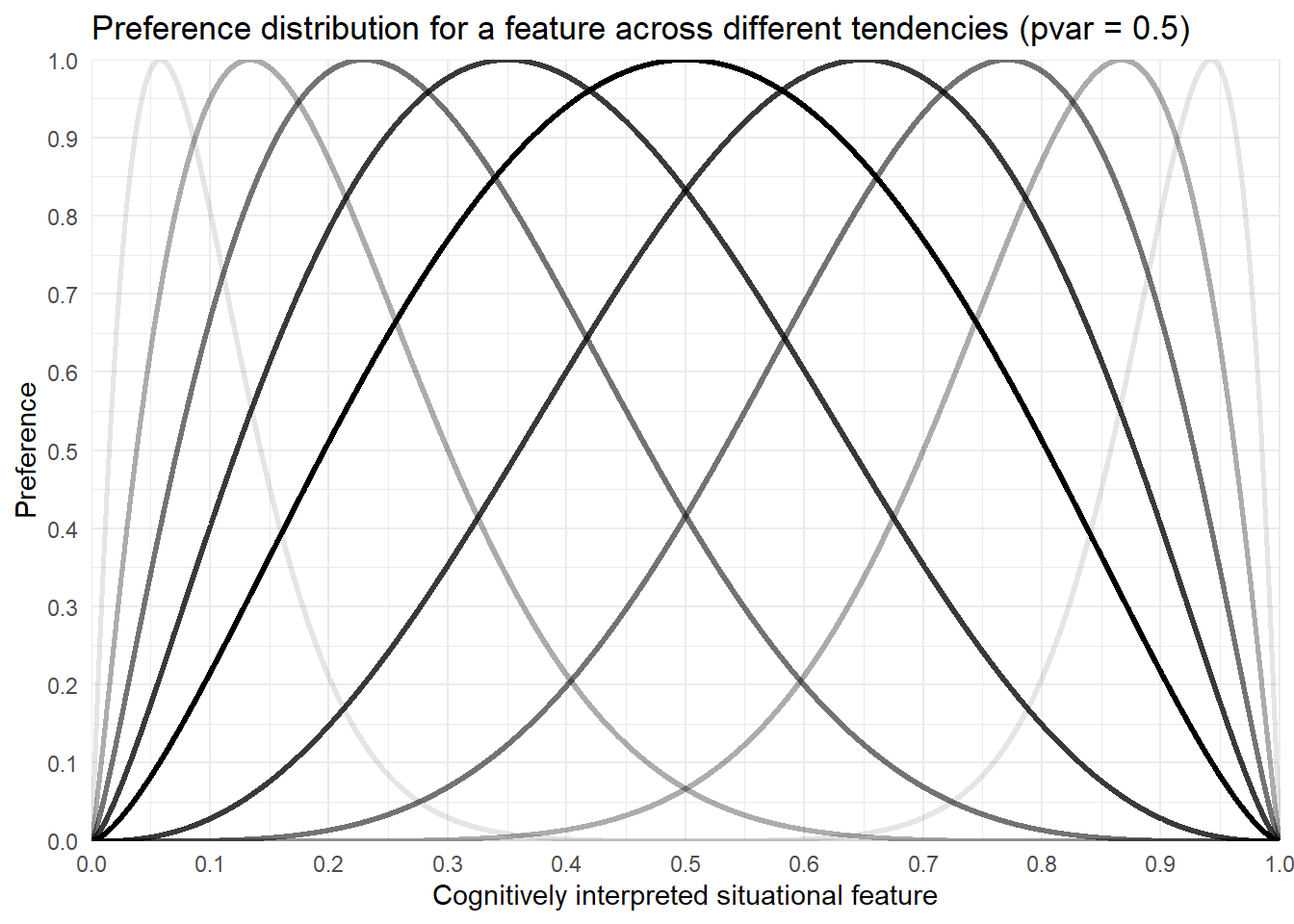
The following plot illustrates the preference distribution for a specific feature. The x-axis represents the cognitively interpreted expression of the feature, while the y-axis depicts the corresponding preference. Accordingly, the curve reaches its maximum at the point where the individual feels most comfortable.

plot_features_dist(tendencies = c(0.1, 0.2, 0.3, 0.4, 0.5, 0.6, 0.7, 0.8, 0.9),
                   pvar = 0.5,
                   title ="Preference distribution for a feature across different tendencies (pvar = 0.5)")
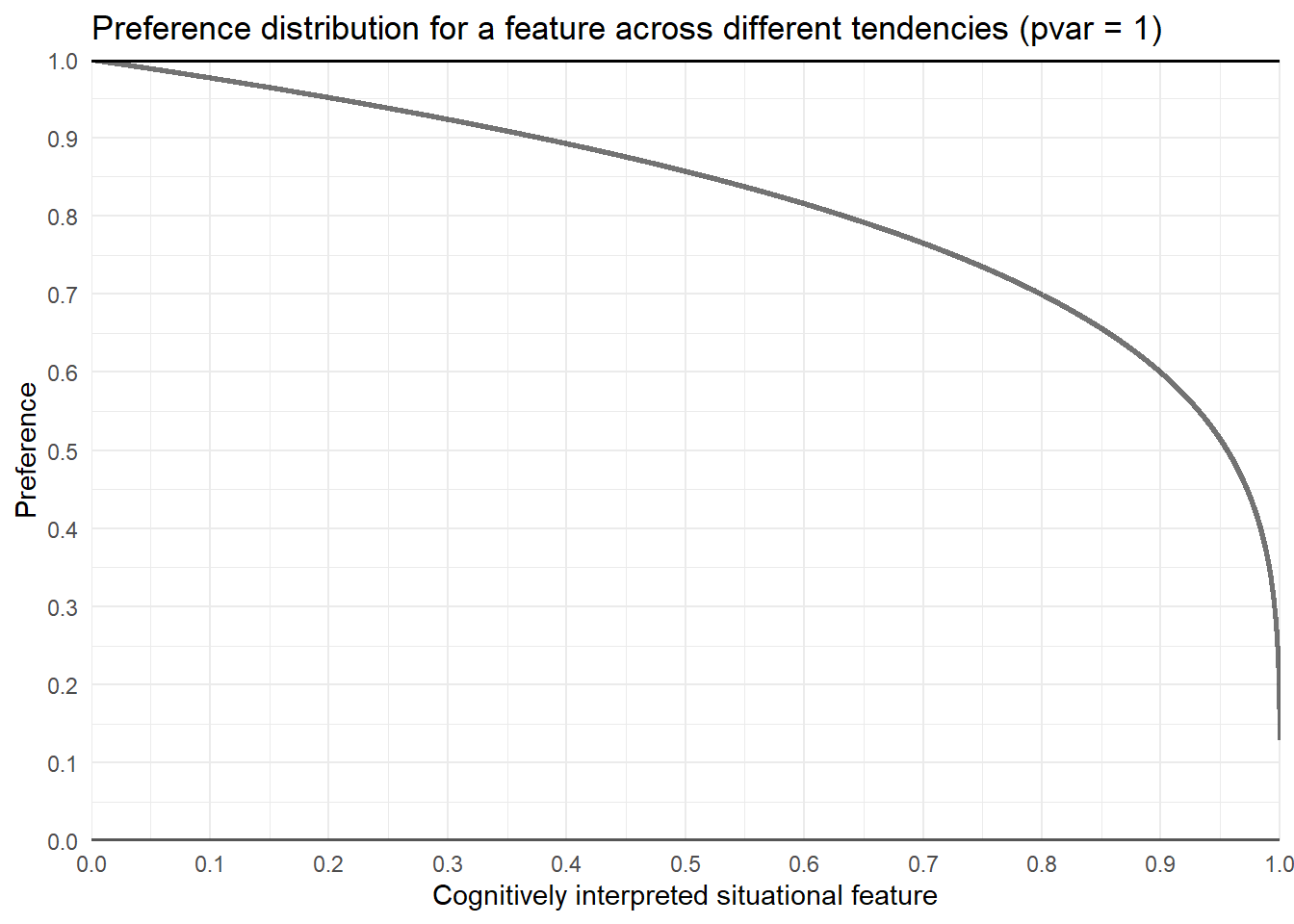
In the following special case, a “maximum” variation is assumed (pvar = 1). As can be seen, a tendency of 0.5 results in a nearly uniform distribution. This can be interpreted as indifference with respect to this feature.

plot_features_dist(tendencies = c(0.4, 0.45, 0.5, 0.55, 0.6),
                   pvar = 1,
                   title ="Preference distribution for a feature across different tendencies (pvar = 1)")
Alternativ Probability Definition

features_dist <- function(x, tendencies, pvar, output = NULL, eps = 1e-6) {
    par <- calc_beta_par(tendencies, pvar, output = c("a", "b", "pvar"), eps)
    lenpar <- length(par$a)
    lenx <- length(x)
    df <- data.frame(
        set = rep(1:lenpar, each = lenx),
        x = rep(x,lenpar),
        a = rep(par$a, each = lenx),
        b = rep(par$b, each = lenx),
        pvar = rep(par$pvar, each = lenx)
    )
    df$freq <- dbeta(df$x, df$a, df$b)
    df$prob <- pbeta(df$x, df$a, df$b)
    df$probx <- df$freq / (1 + df$freq)
    
    if (is.null(output)) {
        return(df)
    } else {
        missing <- setdiff(output, colnames(df))
        if (length(missing) > 0) {
            stop("Unknown output columns: ", paste(missing, collapse = ", "))
        } else {
            df[, output]            
        }
    }
}
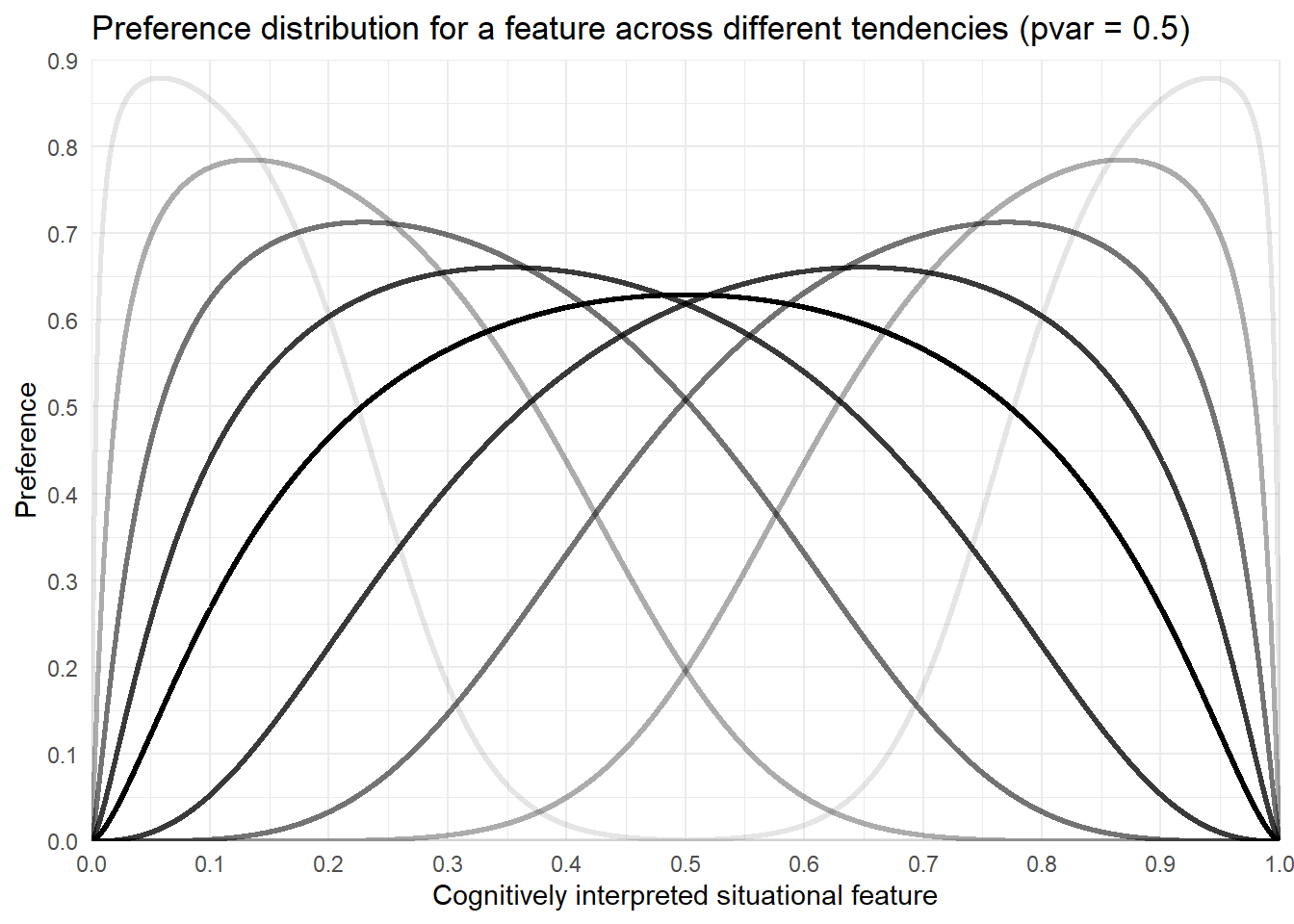
plot_features_dist(tendencies = c(0.1, 0.2, 0.3, 0.4, 0.5, 0.6, 0.7, 0.8, 0.9),
                   pvar = 0.5,
                   title ="Preference distribution for a feature across different tendencies (pvar = 0.5)",
                   save = "Features")
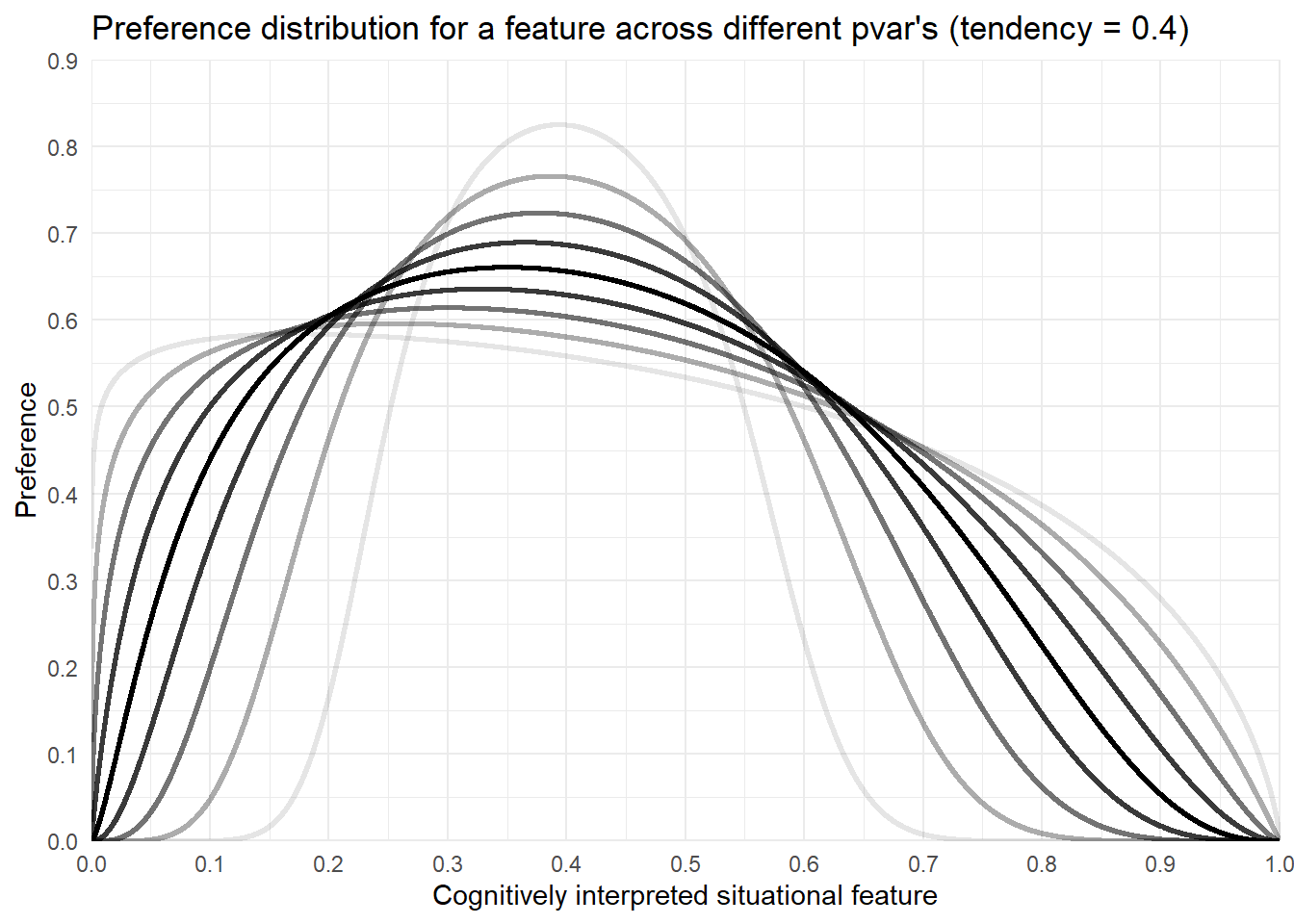
plot_features_dist(tendencies = 0.4,
                   pvar = c(0.1, 0.2, 0.3, 0.4, 0.5, 0.6, 0.7, 0.8, 0.9),
                   title ="Preference distribution for a feature across different pvar's (tendency = 0.4)")
< Back

Back to top
Source Code
---
title: "Features"
author: "Hubert Bächli"
date: last-modified
---

```{r setup, include=FALSE}
knitr::opts_chunk$set(echo = TRUE)
library(here)
library(tidyverse)
```

# Describing Features as Distributions

## Parameter pvar

This parameter describes the variance of the beta distribution. For mathematical reasons, the variance is defined relative to the maximum variance permitted for a given mean value. As a consequence, *pvar* is constrained to values greater than 0 and less than or equal to 1. This definition ensures that the resulting beta distribution parameters are always greater than 1, and that the mode of the distribution lies within the interval (0,1).

### Maximal aloud Varince for a given Tendency

```{r}
tendencies <- 0.3
s_min <- max(1/tendencies,1/(1-tendencies))
s_min
var_max <- tendencies * (1-tendencies) / (s_min + 1)
var_max
```

Formally, *pvar* is defined as follows:

```{r}
SD <- 0.2
pvar <- max(min(SD^2 / var_max, 1),0.01)
pvar
varianz <- pvar * var_max 
varianz
```

## Parameters of the beta distribution

Finally, this formulation makes it possible to derive a precision parameter and, based on it, the corresponding beta distribution parameters from only two inputs (Tendency, pvar)

```{r}
calc_beta_par <- function(tendencies, pvar, output = NULL, eps = 1e-6) {
    len <- length(tendencies * pvar)
    df <- data.frame(ten = rep(0, len))
    
    df$ten <- pmin(pmax(tendencies, eps), 1 - eps)
    df$pvar <- pmax(pmin(pvar, 2), eps)
    
    df$ab_min <- pmax(1/df$ten,1/(1-df$ten))
    df$var_max <- df$ten * (1 - df$ten) / (df$ab_min + 1)
    
    df$var <- df$pvar * df$var_max
    
    df$prec <- (df$ten * (1 - df$ten)) / df$var - 1
    
    df$a <- df$prec * df$ten
    df$b <- df$prec * (1 - df$ten)

    if (is.null(output)) {
        return(df)
    } else {
        missing <- setdiff(output, colnames(df))
        if (length(missing) > 0) {
            stop("Unknown output columns: ", paste(missing, collapse = ", "))
        } else {
            df[, output]            
        }
    }
}

calc_beta_par(c(0.1, 0.3, 0.5, 0.7, 0.9), 1)
calc_beta_par(c(0.1, 0.3, 0.5, 0.7, 0.9), 0.5)
calc_beta_par(c(0.1, 0.3, 0.5, 0.7, 0.9), 0)
calc_beta_par(c(0.1, 0.3, 0.5, 0.7, 0.9), 2)
```

## Frequency and probability distribution

Function that calculates the frequency distribution and the probability distribution for each value of x, for all given parameter sets (tendencies and *pvar*).

```{r}
features_dist <- function(x, tendencies, pvar, output = NULL, eps = 1e-6) {
    par <- calc_beta_par(tendencies, pvar, output = c("a","b"), eps)
    lenpar <- length(par$a)
    lenx <- length(x)
    df <- data.frame(
        set = rep(1:lenpar, each = lenx),
        x = rep(x,lenpar),
        a = rep(par$a, each = lenx),
        b = rep(par$b, each = lenx)
    )
    df$freq <- dbeta(df$x, df$a, df$b)
    df$mode <- (df$a - 1) / (df$a + df$b - 2)
    df$mode <- pmin(pmax(df$mode, 0), 1)
    df$max <- ifelse(is.na(df$mode), 
                     df$freq, 
                     dbeta(df$mode, df$a, df$b))
    df$probx <- df$freq / df$max
    df$prob <- pbeta(df$x, df$a, df$b)

    if (is.null(output)) {
        return(df)
    } else {
        missing <- setdiff(output, colnames(df))
        if (length(missing) > 0) {
            stop("Unknown output columns: ", paste(missing, collapse = ", "))
        } else {
            df[, output]            
        }
    }
}

features_dist(x = c(0, 0.5, 1),
              tendencies = 0.6, 
              pvar = 1)

features_dist(x = c(0, 0.5, 1),
              tendencies = c(0.3, 0.5, 0.7), 
              pvar = 0.5, 
              output = c("set", "freq", "prob", "probx"))
```

### Visualisation and interpretation

```{r, echo = FALSE}
plot_features_dist <- function(tendencies, pvar, title, save = NULL) {
    x <- seq(0.0001, 0.9999, 0.0001)
    len <- length(tendencies * pvar)
    df <- features_dist(
        x = x,
        tendencies = tendencies,
        pvar = pvar 
    )
    
    ymax <- ceiling(max(df$probx) * 10) / 10
    
    df$alpha <- (df$set - 1) / (len - 1)  
    df$alpha <- 0.1 + 0.9 * (1 - 2 * abs(df$alpha - 0.5))
    plt <- ggplot(
        df, aes( x = x, y = probx, group = set)) +
        geom_line(aes(alpha = alpha), linewidth = 1) +
        scale_alpha_identity() +
        scale_x_continuous(
            limits = c(0, 1),
            breaks = seq(0, 1, by = 0.1),
            expand = c(0, 0)) +
         scale_y_continuous(
             limits = c(0, ymax),
             breaks = seq(0, ymax, by = 0.1),
             expand = c(0, 0)) +
        labs(
            x = "Cognitively interpreted situational feature",
            y = "Preference",
            title = title) +
        theme_minimal()
    
    if (!is.null(save)) {
        dir_path <- "img"  
        dir.create(dir_path, recursive = TRUE, showWarnings = FALSE)
        file_path <- file.path(dir_path, paste0(save, ".png"))
        
        ggsave(filename = file_path,
               plot = plt,
               width = 8,
               height = 4,
               units = "in",
               dpi = 300)
    }

    plt
}
```

The following plot illustrates the preference distribution for a specific feature. The x-axis represents the cognitively interpreted expression of the feature, while the y-axis depicts the corresponding preference. Accordingly, the curve reaches its maximum at the point where the individual feels most comfortable.

```{r}
plot_features_dist(tendencies = c(0.1, 0.2, 0.3, 0.4, 0.5, 0.6, 0.7, 0.8, 0.9),
                   pvar = 0.5,
                   title ="Preference distribution for a feature across different tendencies (pvar = 0.5)")
```

In the following special case, a "maximum" variation is assumed (*pvar* = 1). As can be seen, a tendency of 0.5 results in a nearly uniform distribution. This can be interpreted as indifference with respect to this feature.

```{r}
plot_features_dist(tendencies = c(0.4, 0.45, 0.5, 0.55, 0.6),
                   pvar = 1,
                   title ="Preference distribution for a feature across different tendencies (pvar = 1)")
```

## Alternativ Probability Definition

```{r}
features_dist <- function(x, tendencies, pvar, output = NULL, eps = 1e-6) {
    par <- calc_beta_par(tendencies, pvar, output = c("a", "b", "pvar"), eps)
    lenpar <- length(par$a)
    lenx <- length(x)
    df <- data.frame(
        set = rep(1:lenpar, each = lenx),
        x = rep(x,lenpar),
        a = rep(par$a, each = lenx),
        b = rep(par$b, each = lenx),
        pvar = rep(par$pvar, each = lenx)
    )
    df$freq <- dbeta(df$x, df$a, df$b)
    df$prob <- pbeta(df$x, df$a, df$b)
    df$probx <- df$freq / (1 + df$freq)
    
    if (is.null(output)) {
        return(df)
    } else {
        missing <- setdiff(output, colnames(df))
        if (length(missing) > 0) {
            stop("Unknown output columns: ", paste(missing, collapse = ", "))
        } else {
            df[, output]            
        }
    }
}

```

```{r}
plot_features_dist(tendencies = c(0.1, 0.2, 0.3, 0.4, 0.5, 0.6, 0.7, 0.8, 0.9),
                   pvar = 0.5,
                   title ="Preference distribution for a feature across different tendencies (pvar = 0.5)",
                   save = "Features")
```

```{r}
plot_features_dist(tendencies = 0.4,
                   pvar = c(0.1, 0.2, 0.3, 0.4, 0.5, 0.6, 0.7, 0.8, 0.9),
                   title ="Preference distribution for a feature across different pvar's (tendency = 0.4)")
```

# \< [Back](../Personality.qmd#self_concept)